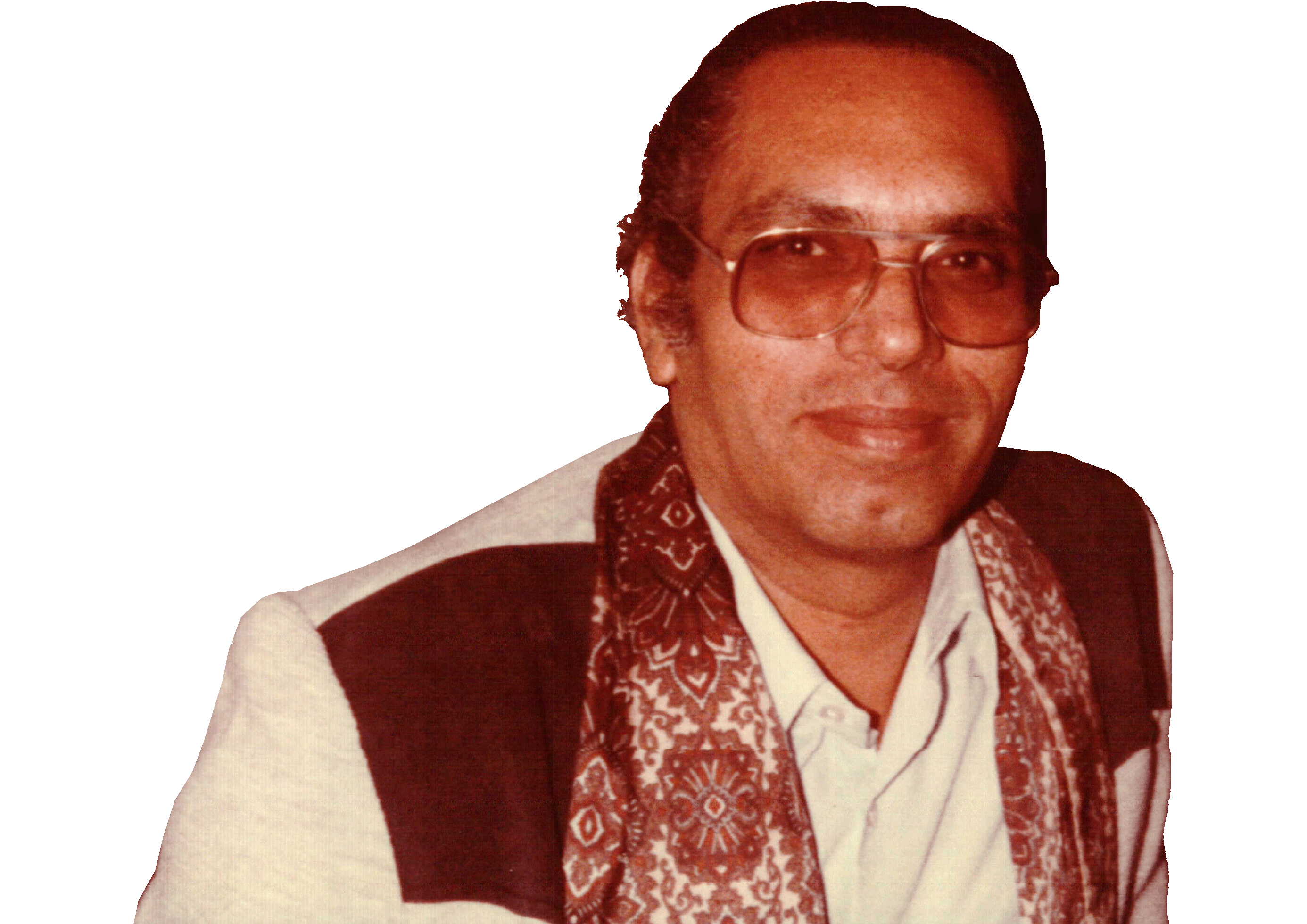
Prof. Dr. Kamal El-Sarrag
A pioneer of modern Egyptian painting
Former President of Helwan University and former Professor and Dean of the Faculty of Fine Arts in Cairo, Dr. Kamal El-Sarrag is one of the key artists who re-imagined the Arabic letter—especially the letter sīn—in contemporary visual compositions spanning more than six decades.
From the studios of the Faculty of Fine Arts in Cairo to the Venice Biennale and private collections around the world, Kamal El-Sarrag's practice weaves together deep academic knowledge with a distinctly innovative approach to the Arabic letter within the pictorial space.
Academic Career
From teaching assistant to President of Helwan University-
1960Appointed as a teaching assistant at the Faculty of Fine Arts, Cairo – Painting Department, marking the beginning of his academic career.
-
1967Appointed Lecturer in the Painting Department at the Faculty of Fine Arts after obtaining his PhD from Venice.
-
1974Promoted to Assistant Professor at the Faculty of Fine Arts, Cairo.
-
1980Promoted to full Professor in the Painting Department, coinciding with his State Encouragement Award and the Order of Sciences and Arts, First Class.
-
1981Appointed Vice-Dean of the Faculty of Fine Arts, Cairo, while continuing his teaching and artistic work.
-
1984Appointed Dean of the Faculty of Fine Arts, Cairo, during a period marked by strong academic and artistic presence.
-
1986Appointed President of Helwan University, combining high-level university leadership with extensive academic and artistic experience.
Artistic Roles
Committees, juries & cultural engagement- Fine Arts Committee, Supreme Council of Culture (1980–86)
- Exhibitions & Acquisitions Committee (1973–86)
- State Encouragement Awards jury (1985–90)
- Education Committee, National Democratic Party (1987–90)
- Jury for logo of the African Games (1989)
- National Specialized Councils & National Council for Arts, Literature, and Media
- Permanent professorial appointments committee (2001–2012)
Key Facts
Awards, affiliations & representationThe Journey of the Letter Sīn
The Arabic letter as a contemporary visual elementA large part of Kamal El-Sarrag's work draws inspiration from the forms of the Arabic alphabet—particularly the letter sīn (س), which, since the late 1960s, has become a recurring visual focus in his artistic practice.
He does not treat the letter as a linguistic sign alone, but as a compositional unit with its own weight, rhythm, and trajectory within the artwork. The letter becomes line, mass, light, shadow, and movement in the pictorial space, creating layers of visual reading that oscillate between clarity and abstraction.
Over the decades, the letter sīn has appeared in many configurations: sometimes as an explicit central element in the composition, and at other times as a more abstract presence embedded within fields of color and line—a continuous journey between calligraphic suggestion and painterly presence.
This approach places his work within a broader trend in contemporary Arab art that re-examines Arabic calligraphy, yet his practice retains its distinct character through a subtle color sensibility and a tendency to build calm, focused visual spaces.
Selected Collections & Exhibitions
Local and international presenceWorks by Kamal El-Sarrag are held in a number of museums and cultural institutions, including:
- Museum of the Faculty of Fine Arts in Cairo and Alexandria
- Egypt Academy in Rome
- Museum of Modern Art in Cairo
- Private collections in Egypt and across many countries around the world
He has held more than thirty-five solo exhibitions in Egypt, Italy, Belgium, and the United States, and has taken part in the major group exhibitions that represented Egypt at home and abroad since 1960.
One of the milestones of his international presence was his participation in the Venice Biennale in 1984, where he presented an Egyptian painting experience within a global context, grounded in his own vision of the Arabic letter and pictorial composition.
Biography
Early life, education & key milestonesKamal El-Sarrag was born in 1934 in the city of Kafr El-Zayat in Gharbia Governorate. He joined the Faculty of Fine Arts in Cairo and graduated from the Painting Department in 1960 with highest honors. He later pursued postgraduate studies and obtained a PhD in Painting from the Academy of Fine Arts in Venice, Italy, in 1967—also with distinction.
In recognition of his contribution to the Egyptian art movement, he received the State Encouragement Award in Painting in 1980, and in the same year he was awarded the Order of Sciences and Arts, First Class.
His works are housed in the Museum of the Faculty of Fine Arts in Cairo and Alexandria, at the Egypt Academy in Rome, in the Museum of Modern Art in Cairo, and in private collections in Egypt and many other countries.
His name is listed in the National Encyclopedia of Notable Egyptian Figures issued by the State Information Service in Cairo, in recognition of his prominent role in Egypt's cultural and artistic life.
He was also hosted by Egyptian radio in a number of programs, including:
- "Witness of the Era" – General Program – with broadcaster Omar Bateesha (1988)
- "Lights on the Other Side" – Voice of the Arabs – with broadcaster Nagwa Abou El-Naga (1989)